
Winning in the Zero-Click Search Era – 2025 Guide
Zero-click searches occur when users receive answers directly on SERP without needing to click to a website. These answers come via featured snippets, knowledge panels, People Also Ask, or AI-generated responses (AI Overviews).
This behavior is driven by user preference for fast and convenient answers especially for simple, factual queries.
According to current data, about 60% of all Google searches end without a click! Over 75% of mobile searches resulting in no external visit. This shift reflects a new era of information consumption, one that prioritizes speed over source exploration.
What Features Are Responsible for Zero-Click Searches
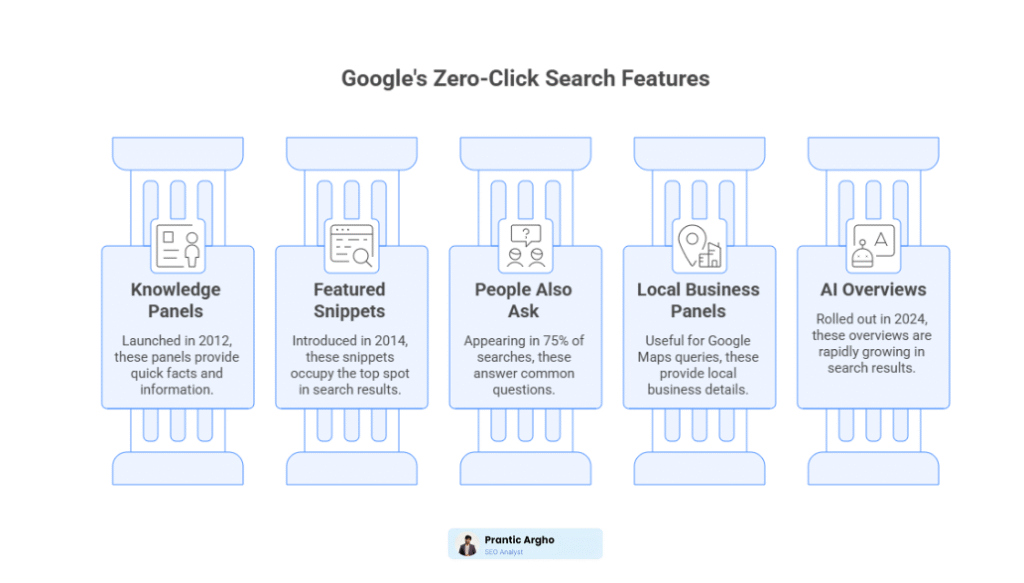
Google has introduced a range of features over the years that directly answer queries without requiring clicks. These include:
- Knowledge Panels – launched with the Knowledge Graph in 2012
- Featured Snippets – introduced in 2014, occupying “position zero” in results
- People Also Ask – now appear in roughly 75% of all searches
- Local Business Panels – especially useful for Google Maps-based queries
- AI Overviews – rolled out in 2024, appearing in up to 47% of searches and growing rapidly
These features are designed to keep users on the results page, offering a better user experience while challenging traditional traffic-based SEO strategies.
Timeline of Zero-Click Search Evolution (2005–2025)
| Year | Feature Introduced | Description |
|---|---|---|
| 2005 | Google Local | Business info directly in SERPs |
| 2007 | Universal Search | Images, news, and videos integrated |
| 2010 | Google Instant | Live results as users type |
| 2012 | Knowledge Graph / Panels | Rich factual entity data |
| 2014 | Featured Snippets | Answer boxes shown above organic results |
| 2016 | People Also Ask expansion | Increased prominence in SERPs |
| 2024 | AI Overviews | Generative summaries of search queries |
Historical Data About Google Zero-Click Searches
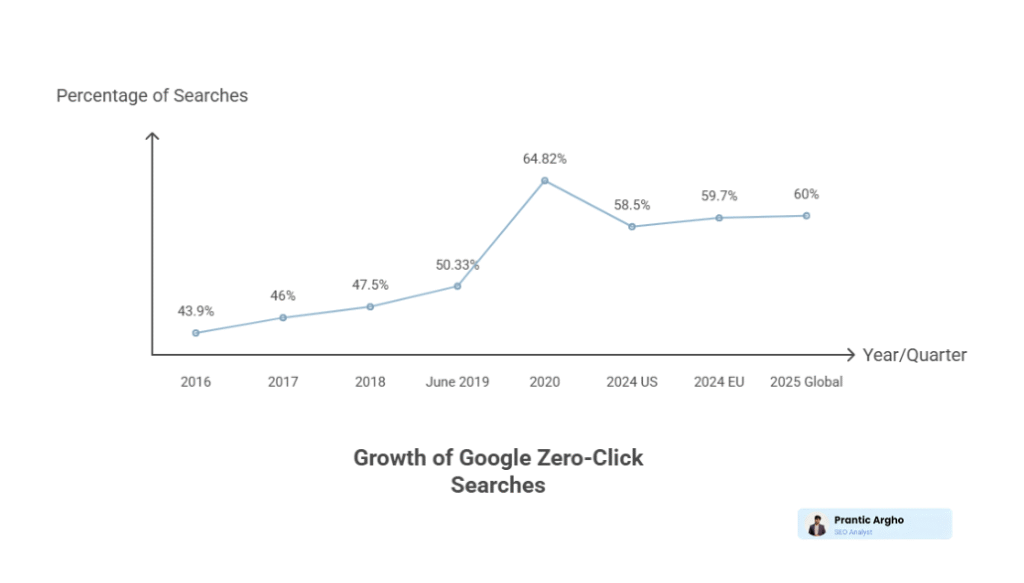
The growth trajectory of zero-click search has been consistent:
- 2016 Q1 – 43.9%
- 2017 Q1 – 46%
- 2018 Q1 – 47.5%
- June 2019 – 50.33%
- 2020 – 64.82% (spike driven by COVID-19 and mobile usage)
- 2024 – 58.5% of US searches; 59.7% in the EU
- 2025 – ~60% globally, with mobile nearing 75%
- Mobile searches show significantly higher zero-click rates due to condensed UI and on-the-go behavior.
Source: SparkToro, Semrush and Search Engine Land
Learn More About: SEO, AEO and GEO
Methodological Conflicts Around Zero-Click Data
There is notable debate around the actual percentage of zero-click searches.
- SparkToro, led by Rand Fishkin, often reports higher zero-click rates.
- In 2021, Google claimed these studies were misleading.
- In contrast, Semrush’s 2022 data showed just 25.6% of desktop and 17.3% of mobile searches as zero-click, highlighting the methodological complexity.
The truth likely lies between these extremes. But the key trend remains unchanged! more searches end on Google itself.
The Rise of AI Overviews
In May 2024, Google introduced AI Overviews AI-generated summaries that synthesize answers across the web and present them directly in search results.
- Appears in up to 47% of current US searches
- Could expand to 80% of informational queries
- Expected to reach 1 billion users globally by end of 2024
- Early data shows a 70% drop in organic CTR where AI Overviews are present
This represents a profound shift, pushing Google further toward being a destination, not just a search engine.
Source: Google I/O 2024, Search Engine Journal
How to Win in the Zero-Click Era
SEO is not dead, but it has evolved. To stay visible in a zero-click environment, websites and creators must change how they think about content, branding, and authority.
1. Build Brand Authority First
Google favors sources that are recognized, cited, and trusted. Build your brand so that people and AI associate your name with reliability and expertise.
2. Cover Full Intent
Don’t just optimize for a keyword answer the follow-up questions, alternatives, and subtopics. Own the entire topic, not just the top keyword.
3. Structure Content Clearly
Use clear HTML structures with headings, tables, bullet points, and summaries. This helps Google and AI tools extract and display your content in rich results.
4. Be a Primary Source
Original data, expert insights, and firsthand experiences rank better and are more likely to be cited by AI Overviews and snippets.
5. Go Multimodal
Support your blog posts with images, videos, audio clips, charts, or tools. Multimodal content tends to rank higher and is more useful for generative AI.
6. Focus on Direct Relationships
Build your email list, community, and loyal reader base. That way, you’re not entirely dependent on search engines for reach.
7. Optimize for AI Citation
Write factually, cite sources, use clear language, and maintain credibility. This improves the likelihood that your content is cited or linked by AI-generated summaries.
Final Thoughts
The era of 10 blue links is over. In its place stands an answer engine fast, intelligent, and increasingly self-contained. But for creators and businesses who adapt, this isn’t the end, it’s a transformation.
The future belongs to those who create for visibility, trust, and usefulness not just traffic.
Read Helpful Resources: SEO Is Changing by Brian Dean